History of the CTFPHC
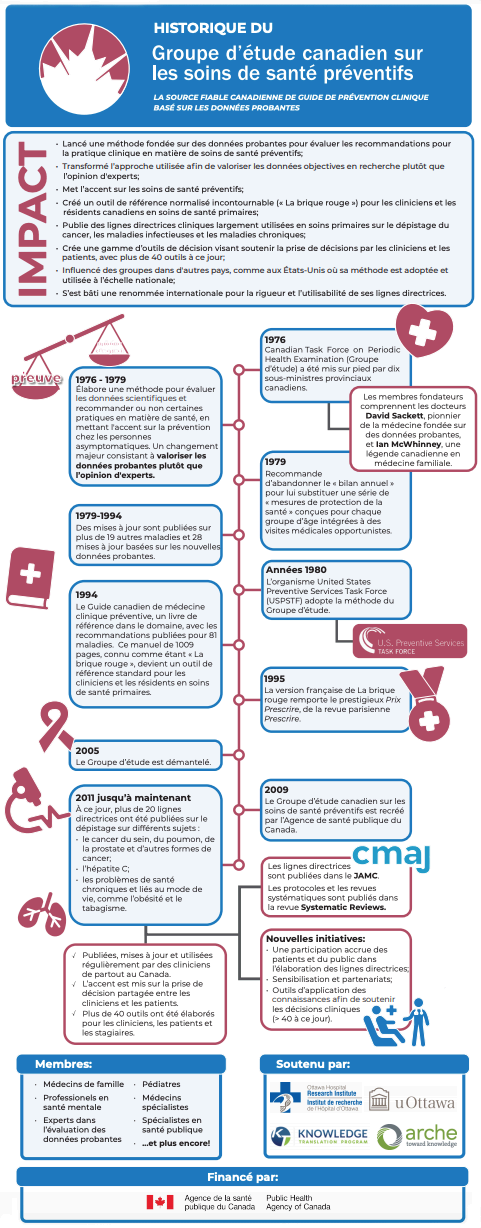
The Canadian Task Force on Preventive Health Care, formerly known as the Canadian Task Force on the Periodic Health Examination, was founded in September 1976 by the Conference of Deputy Ministers of Health of Canada's ten provinces. From 1976 to 1979, the Canadian Task Force developed a method for appraising scientific evidence to formulate recommendations on the inclusion or exclusion of certain preventive measures as part of the periodic health examination of asymptomatic patients.
The Canadian Task Force took the view at the time, as it still does today, that in clinical practice care providers are called upon to make binary decisions regarding their patients: "to act" or "not to act." However, it also recognizes that, for many preventive interventions, scientific evidence does not lend itself to such simple, two-dimensional choices. What distinguishes the Canadian Task Force's decision-making process from the conventional method is that it favours evidence over consensus in making prevention decisions.
In its first report, published in 1979, the Canadian Task Force reviewed the scientific evidence on the prevention of 78 conditions and reached a landmark recommendation: the undefined "annual health checkup" should be abandoned in favour of a series of age-specific "health protection measures" that could be applied during medical visits other than annual checkups.
From 1979 to 1994, the Canadian Task Force published 9 updates, in which it issued recommendations on 19 additional conditions and revised 28 earlier reports in light of new scientific evidence. In 1994, it published the Canadian Guide to Clinical Preventive Health Care, a landmark compilation of its recommendations covering 81 conditions. This 1,009-page work, affectionately known as the "red brick," became the standard reference for Canadian primary care providers. In 1995, the French version of the "red brick" won the prestigious Prix Prescrire awarded annually by the Paris journal Prescrire to a medical or pharmaceutical publication.
In the 1980s, the U.S. Preventive Services Task Force (USPSTF) adopted the Canadian Task Force's method almost in its entirety. To date, both task forces have applied this method successfully to the evaluation of interventions intended to prevent more than 200 conditions, and this method is today recognized and used worldwide for the development of clinical practice guidelines and public health policies. The Canadian and U.S. Task Forces continue to maintain a close and fruitful collaboration. The recommendations of the Canadian Task Force, like those of the USPSTF, are currently used in the "Put Prevention into Practice" initiative, to create a resource that clinicians can consult when considering certain preventive interventions.
In 2005, the Canadian Task Force on Preventive Health Care was disbanded.
In 2010, with a renewed mandate and vision, the Canadian Task Force was re-established with the help of the Public Health Agency of Canada (PHAC) to build on its 25 years of excellence.